Solid Earth Unveils New Recursive™ MLS Platform, Association Software, and Safe AI Tools at RESO
Solid Earth launches Recursive™ MLS, integrated association management software, and Recursive AI™ with data ownership and built-in AI safety...
Explore how Recursive AI connects member identity, live MLS searches, configured policies, and visible results in a conversational workflow.
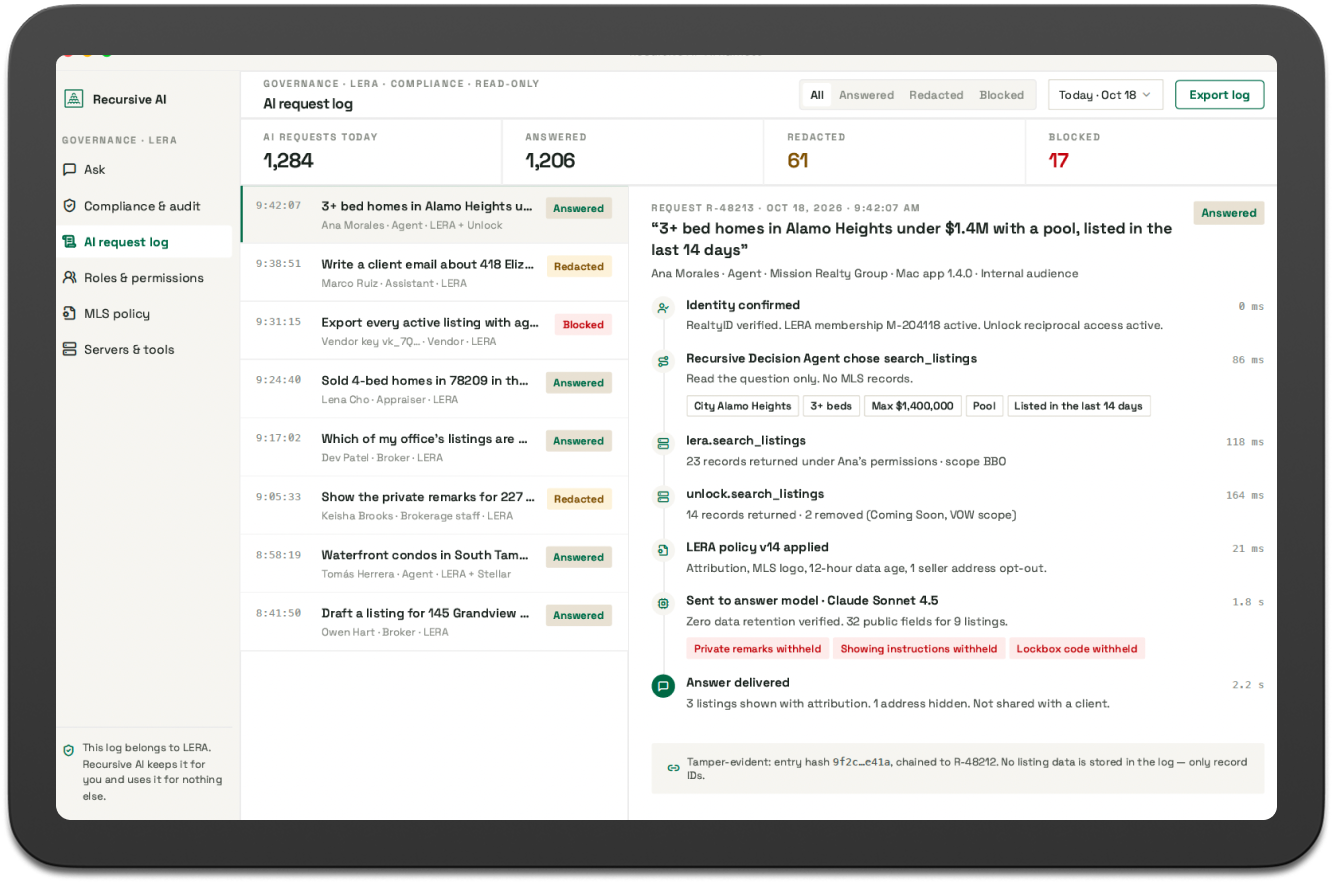
“Show me three-bedroom homes in Alamo Heights under $1.4 million with a pool, listed in the last two weeks.”
The request takes seconds to say. Producing a useful answer requires several decisions.
But this begs the questions:
Which MLSs can this member search? Which listings are available under each connection? How should overlapping records be handled? Which fields can be sent to the answer model? What information must appear alongside the results?
In our first article, we introduced Recursive AI, otherwise known as the MLS harness: the software coordinating the work around an AI model. Recursive AI puts that concept into the context of a member’s daily MLS tasks.
Its value becomes clearer when you follow a request through the product.
Recursive AI interprets the member’s question and selects the tools and filters needed to act on it.
For example, “three-bedroom homes” becomes a minimum bedroom count. The price ceiling, pool requirement, location, and listing window become search parameters. All from basic conversation, the way most agents are already doing business.
That distinction matters. The Recursive AI agent reads the question to plan the search before MLS records enter the answer-generation stage.
It gives the workflow a defined starting point: retrieve relevant information through an authorized connection, then use that information to prepare a response.
Recursive AI connects the request to the member’s verified identity and permissions. Connected MLS servers apply the relevant data scope before returning records. Because of this, the same question can produce different results for different users.
For a member with access to multiple MLSs, Recursive AI coordinates searches across those sources and merges cross-listed duplicates thanks to the RealtyID™. The results retain source attribution so the member can see where the information originated. This is particularly useful for agents working across market boundaries. One request can coordinate several searches while preserving the distinctions between the underlying sources.
Access to one MLS does not establish access to another. Each connection still has to respect its own permissions.
Retrieving records is one stage. Preparing them for the intended audience is another. Recursive AI’s console brings together settings for data access, field visibility, attribution, sharing, listing writes, and other supported behaviors. Its policy hierarchy allows brokerage and office restrictions to tighten the MLS’s requirements.
That gives administrators a place to configure how supported workflows should behave.
For the member, those decisions appear in the experience: a field is withheld, an address is hidden, attribution accompanies a listing, or a request cannot proceed.
A conversational interface can make a complicated task feel simple. MLS admins still need to understand the process behind it. Recursive AI’s request view shows the selected filters, connected tool calls, rules applied, and fields withheld from the answer model.
The audit view extends that record with identity, policy versions, timing, and outcomes.
These details support a practical conversation when a member asks why a result was excluded or why a field was unavailable. They also give administrators a way to investigate behavior beyond the final answer.
The best way to evaluate Recursive AI is to bring a real member workflow.
Choose a search that crosses MLS boundaries. Include a restricted field or seller preference. Ask to see both the member result and the administrative record.
That walkthrough connects the product’s architecture to the work your organization supports every day.
Book a Recursive AI walkthrough and follow a member request from question to result.
Solid Earth launches Recursive™ MLS, integrated association management software, and Recursive AI™ with data ownership and built-in AI safety...
Solid Earth delivers reliable real estate technology, helping MLSs, associations, and brokerages move to production with accuracy, trust, and...
Learn how an AI harness can coordinate MLS tasks with permissions, configured rules, approvals, and records of completed actions.